

Strategy execution carries real weight. The decisions organizations make determine where teams allocate resources and whether long-term goals become measurable progress. In some organizations, these decisions still rely on instinct. While gut feeling is valuable, it often fills the gaps left by unclear or inaccessible data.
Those gaps typically stem from familiar data living in separate systems, definitions varying across teams and a weak confidence in the numbers because of unclear origins. When trust in data erodes, conversations can shift toward opinions rather than evidence, slowing execution and making alignment harder to sustain.
Defining a data-driven culture changes this dynamic. When organizations foster a data-driven culture within business units, they can make proactive decisions. Leaders gain clarity and execution improves because actions are guided by shared insight. This approach supports consistent organizational growth by turning learning into a repeatable process.
Explore the three pillars of a data-driven culture.
In This Article
- 1. Enable Accessibility, Literacy and Transparency
- 2. Align Decisions With Strategy
- 3. Foster a Culture of Experimentation and Learning
1. Enable Accessibility, Literacy and Transparency
Accessibility, literacy and transparency form the foundation of a data-driven culture because they determine whether data becomes a shared decision asset or remains locked inside reports that few people use or trust. Here are some ways organizations can ensure these elements work in tandem so data naturally flows into day-to-day decisions.
Democratize Data
Data democratization in business involves making relevant data available and understandable to the people responsible for acting on it. When employees and analysts can easily find the correct information and understand what it represents, they can better evaluate options and trade-offs.
Here’s how organizations can democratize data:
- Audit access levels: Review who has access to which data and why. Access should reflect decision responsibility. For example, leaders need summary reviews tied to strategic outcomes, while managers and analysts benefit from more detailed operational data. Role-specific access levels shorten decision cycles and support accountability.
- Simplify the source of truth: Multiple systems can report similar metrics with slight variations, which weakens trust and slows execution. Simplifying the source of truth means clearly identifying which system owns which metric and using that consistently across different business operations.
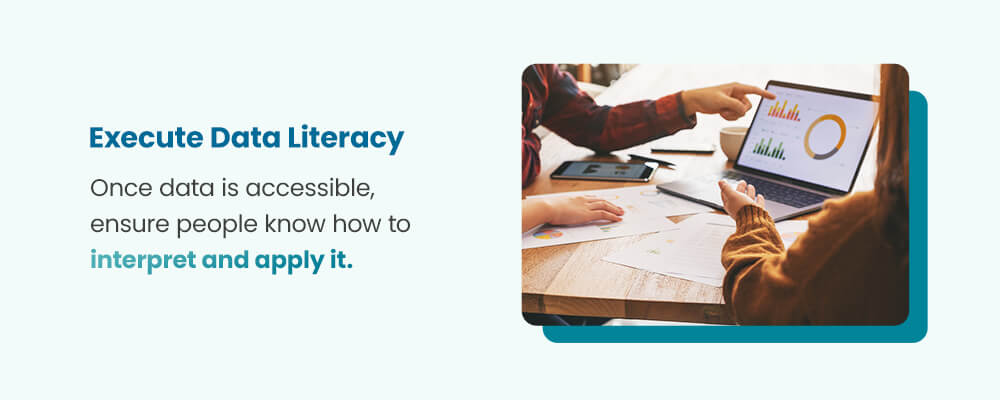
Execute Data Literacy
Once data is accessible, ensure people know how to interpret and apply it. Organizations that intentionally build data literacy across all departments enable teams to engage with data that supports strategy execution.
To implement this strategy, you can:
- Create a data dictionary: A shared data dictionary establishes clear definitions for metrics and data sources. This planning reduces misalignment during planning and performance discussions, especially when teams interpret the same metric through different functional lenses. Over time, it creates a common language that supports cross-functional collaboration.
- Implement role-based training: Different roles interact with data in different ways. Executives need to understand trends and strategic implications, while managers focus on performance indicators and corrective actions. Role-based training keeps learning relevant to how stakeholders make decisions at each level of the organization.
- Host a lunch and learn series: Informal training sessions create space for teams to explore dashboards, ask questions and share how they use data in real scenarios. These sessions reinforce adoption by connecting metrics to planning and execution challenges teams experience in their day-to-day.
Formulate a Strategy for Transparency
When people understand what they are seeing and where it comes from, trust increases. Transparency also reinforces accountability by making progress and challenges visible across the organization.
Organizations can make data transparent through:
- Visual dashboards: Dashboards should represent performance in a clear, intuitive way that reflects strategic priorities. When everyone sees progress through the same platform, alignment improves and discussions stay focused on outcomes.
- The five-second rule: A dashboard should communicate status immediately. Meetings can become more effective if stakeholders can quickly see whether an initiative is on track, needs attention or requires escalation.
- Data lineage transparency: When a number raises questions, users should be able to trace it back to its source. Clear lineage enables teams to resolve discrepancies efficiently, supporting faster learning and adjustment.
2. Align Decisions With Strategy
Data adds value when it supports decisions that propel strategy. When decisions and strategy share the same data foundation, organizations improve focus and maintain momentum across planning and delivery cycles. Explore how to align decisions with strategy.
Leadership’s Role in Decision Governance
Leadership sets expectations for how data informs action. Consistent decision governance helps prevent competing initiatives, fragmented priorities and reactive shifts that dilute strategic focus. When leaders reference the same metrics and frameworks in planning discussions and execution reviews, they reinforce consistency across the organization.
Leaders can enable governance by establishing a small cross-functional team that meets quarterly to review whether the data being collected supports meaningful decision-making. This group brings together perspectives from various departments to evaluate relevance and quality, creating a feedback loop where data evolves alongside strategy.
Collaboration is essential here. When leaders invite dialogue around data, they signal that insights are a shared responsibility, which models how teams should engage with data in their own planning and execution contexts.
Embed Data Into Business Units
To foster a data-driven culture in business units, organizations can adopt an embedded analyst or data champion model. This approach integrates data expertise into teams by having each business unit assign a data champion who understands both the data and the unit’s objectives.
These champions help translate metrics into meaningful narratives, explaining what trends indicate and where adjustments could have an impact. They’ll also secure buy-in from key stakeholders, and oversee the implementation of data-driven initiatives, enabling teams to move from observation to action with greater confidence.
This model also supports consistency. While data champions focus on local context, they remain aligned to enterprise definitions and priorities, reinforcing strategic decisions across an organization.
Establish Key Metrics for Strategy Execution Reporting
Clear, well-structured metrics create a shared understanding of what success looks like during execution. A balanced approach ensures leaders and teams can assess performance from multiple angles, with some metrics to track, including the following:
- Financial metrics: These metrics reflect how strategy influences economic outcomes, including revenue growth, cost efficiency and return on investment. They provide an outcome-level view that helps leaders evaluate whether execution is delivering meaningful impact.
- Customer metrics: Customer-focused measures capture how well strategic priorities impact real-world value. Retention and engagement indicators offer insight into whether execution aligns with customer expectations and market needs.
- Internal process metrics: These metrics assess how effectively the organization operates across processes. They often surface execution opportunities and constraints, supporting timely course correction.
- Learning and growth metrics: This category reflects long-term capability, including skills development and organizational readiness for change. These metrics indicate whether the organization is strengthening the foundations needed to sustain execution.
How to Report KPIs Effectively
Once key metrics are established, reporting can turn measurement into action. Key performance indicators (KPIs) inform how performance information flows through the organization and influence decision-making.
Here’s how to ensure consistent reporting:
- Link KPIs to objectives: Reporting should reinforce the connection between metrics and strategic objectives. This context helps teams understand how their work contributes to broader priorities and keeps decisions aligned with intent.
- Balance leading and lagging indicators: Combining forward-looking indicators with outcome-based measures allows teams to monitor progress while assessing impact. Using ratios can help clarify the relationship between effort and results, supporting more informed adjustments.
- Focus on action: Effective reports highlight where attention is required and who’s responsible for the next step. This emphasis keeps discussions forward-looking and reinforces accountability during execution.
- Show alignment across teams: Consistent reporting structures make it easier to see how initiatives and results connect across business units. This visibility supports coordination as the strategy moves from plan to practice.
Integrate Data Into Strategic Planning
Understanding how to use data for strategic planning involves embedding data into every stage of the planning cycle so strategy is tested and refined through evidence as conditions change. When organizations integrate data into planning workflows, it supports consistent execution.
Specialized data-driven strategic planning software formalizes this approach by providing a structured environment where data, objectives, initiatives, processes and teams remain connected. Here’s how the solution strengthens various steps in the planning process:
- Augments data consolidation: Strategic planning software helps centralize metrics and updates, reducing fragmentation across tools and teams. Leaders and planners can focus on relevance rather than reconciliation by standardizing inputs and aligning teams to strategic objectives.
- Helps extract insights: Connected dashboards and progress views allow leaders to see how initiatives contribute to broader goals, where momentum is building and where attention may be required. Because metrics remain tied to objectives and owners, insights align with context. This clarity supports more productive planning conversations, where decisions are based on patterns and trends.
- Allows for implementation and iteration: Strategy delivers the most value when it guides action. Strategic planning software supports implementation by linking plans to execution, making progress visible and measurable over time. As conditions evolve, leaders can adjust initiatives and refine priorities using current data. This iterative approach turns planning into an ongoing discipline, which allows organizations to learn and adapt while maintaining strategic planning and focusing on execution.
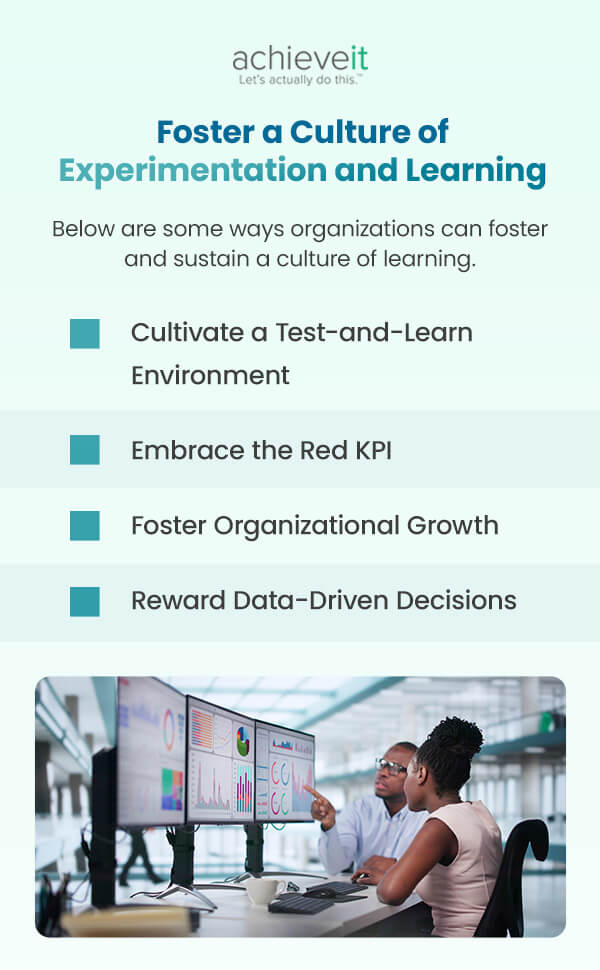
3. Foster a Culture of Experimentation and Learning
A data-driven culture for strategy execution thrives when learning is embedded into how teams operate. A culture of experimentation encourages curiosity and ensures insights continuously inform strategy execution by shifting the focus from preserving status to improving outcomes. Below are some ways organizations can foster and sustain a culture of learning.
Cultivate a Test-and-Learn Environment
Experimentation allows teams to explore possibilities before committing significant resources. When you cultivate a test-and-learn environment, you provide a structured approach to trying new ideas, measuring results and iterating quickly. Organizations can:
- Start with small-scale pilots or controlled experiments to reduce risk while providing meaningful insights.
- Use hypothesis-driven approaches, where every test begins with a clear question and measurable expectation.
- Encourage documentation of learnings, so insights from experiments inform broader decision-making, and teams can draw on successful outcomes when focus shifts.
Embrace the Red KPI
Metrics that underperform, often referred to as red KPIs, provide actionable insight into where strategy or execution requires adjustment. Here are some ways teams can use these KPIs as a means to understand the factors influencing outcomes:
- Treat red KPIs as early warning indicators to guide discussions and prioritize interventions.
- Investigate root causes systematically, looking at both internal process factors and external conditions.
- Share lessons learned across teams to prevent recurring challenges and strengthen collective understanding.
Foster Organizational Growth
Organizational growth through data-driven decisions develops when learning becomes part of how teams work. As stakeholders apply insights consistently, capabilities expand and leaders gain confidence in using evidence to guide direction. This approach strengthens adaptability by allowing the organizations to respond as priorities and conditions evolve.
To sustain this momentum, feedback loops should be institutionalized across the organization. Insights from strategic reviews need to flow back into planning cycles, ensuring decisions reflect current realities.
Cross-functional collaboration also accelerates growth. When learnings from one business unit inform others, teams develop shared practices and reduce duplication of effort. Recognizing and reinforcing improvements that result from learning signals that experimentation and intentional adjustment are behaviors that support data-informed action and progress.
Reward Data-Driven Decisions
Another way to build a data-driven culture is to reinforce what teams have learned. When teams see that their organization acknowledges and supports decisions based on evidence, data use can become part of everyday behavior.
To make recognition relevant, organizations can highlight teams that used data to refine an initiative or acknowledge leaders who adjusted direction based on new insights. What matters is reinforcing the behavior. Consistent reinforcement encourages teams to engage confidently with data, even when insights prompt change or reevaluation.
Rewarding data-driven decisions strengthens trust in the process. Incentives can take many forms, including formal or financial, but they should be visible and consistent. This approach allows teams to learn that using evidence to guide action is expected and supported, reinforcing a culture of continuous learning and growth.

Build and Sustain a Data-Driven Culture With Strategic Planning Solutions From AchieveIt
Building a data-driven culture requires a system that connects strategy to execution in a way that your teams operate. AchieveIt provides strategic planning software that helps organizations bring clarity to how they plan, manage and execute strategy. Our platform connects objectives and stakeholders in one centralized environment, giving you real-time visibility into progress and performance.
The platform supports collaboration and accountability across teams, which helps you keep decisions anchored to strategy as conditions evolve. Our team works alongside you through custom services that strengthen strategy execution capabilities. From implementation and training to adoption tracking and plan optimization, we are dedicated to ensuring your team sustains a data-driven culture.
Request a demo to discover how your organization can move from gut feeling to data-driven decisions.